

In autumn, site conditions change fast. Rain increases, the air cools and the days get shorter. At the same time, many sites are casting slabs, closing in the frame and starting interior works that need dry structures.
When the outdoor air is cold and damp, concrete and other structures do not dry on their own. Drying needs protection, heating and ventilation, and above all knowledge of the actual conditions on site. Without continuous measurement, a problem is often noticed only when coating cannot start or, at worst, after handover.
This article explains what moisture safe construction means, why autumn is a critical season and how condition monitoring helps keep structures dry and the schedule on track.
What does moisture safe construction mean?
Moisture safe construction means that structures are designed, built and protected so that they do not get wet unnecessarily and so that any moisture has time to dry out before they are closed or coated. The goal is simple: the building is handed over dry, and moisture does not later cause damage, indoor air problems or repair costs.
In Finland, moisture management is also a statutory requirement. A moisture management report is attached to the building permit application, describing the project’s moisture management requirements, how they are verified and who is responsible. On site, the responsible site manager ensures that a moisture management plan is prepared before work starts and updated as needed.
Many projects also use the DryChain10 (Kuivaketju10) model. It covers the ten main moisture risks in Finnish construction and defines how their management is verified and documented. Its core idea is that moisture management is a shared responsibility of all parties and that every stage is verified, not assumed.
Verification is exactly where condition monitoring adds the most value.
Why is autumn the most critical season for moisture management?
In autumn, several risks coincide:
- Rain and wetting. An unfinished frame, open openings and unprotected material storage are exposed to water.
- Cold and damp outdoor air. When outdoor air is cool and humid, it cannot be used to dry structures. Drying slows down without heating and controlled ventilation.
- Slow drying of concrete. The moisture in slabs and walls must fall to the level required by the coating manufacturer before coating. In a cool space this takes considerably longer.
- Schedule pressure. Interior works are often started before winter, which increases the temptation to coat too early.
- Changing conditions. Heating can fail, a door can be left open or a dehumidifier can switch off over the weekend. A single manual measurement does not show what happened between measurements.
Condition monitoring in practice
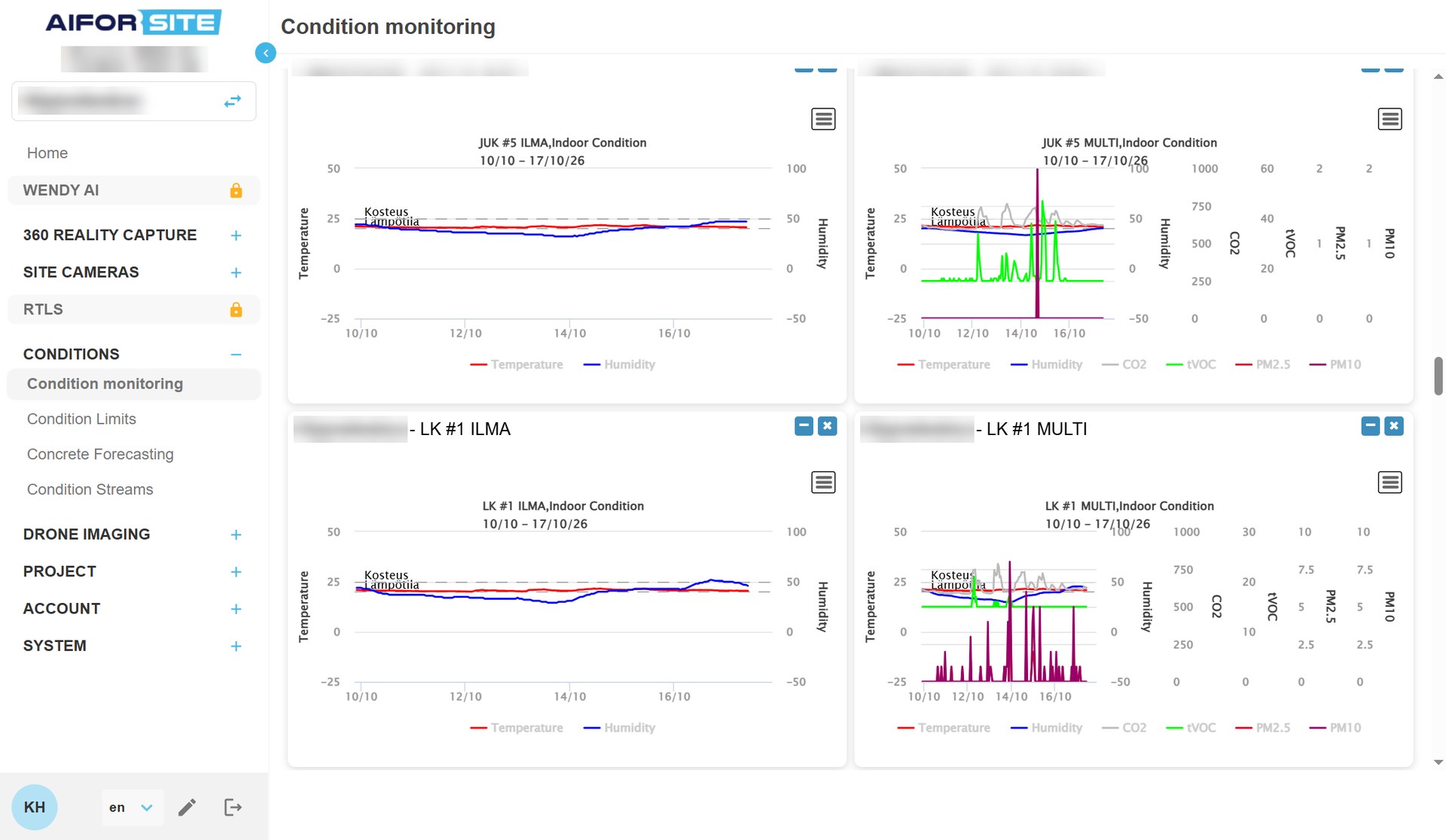
In condition monitoring, wireless sensors are installed on site to continuously measure air temperature, air humidity and air quality, as well as concrete dryness and strength development. The measurements are shown in the web app in real time and stored as history. You can set alarm thresholds yourself, and the system sends a notification automatically when a threshold is exceeded.
This changes moisture management in three ways:
- Deviations are spotted immediately. When the temperature drops or humidity rises, an alarm is triggered instead of waiting for the next site visit.
- Drying can be steered by data. Heating and drying can be targeted at the spaces where conditions are off target.
- Conditions are known at night and at weekends too. Continuous measurement shows what happened in a space when nobody was there.
In autumn it is especially important to follow the strength development of cast in place slabs. In the cold, concrete hardens more slowly, and remote monitoring of the concrete temperature shows when formwork and props can be safely removed. When concrete dryness is measured continuously, coating can be scheduled based on verified data instead of estimates.
The drying forecast tells you when the next work phase can start
A measurement on its own tells you where a structure is now. In site management, however, the key question is: when can we move on?
Aiforsite’s drying forecast for concrete floor slabs answers this. The forecast is based on continuous moisture measurements of the slab and the conditions in the space, and it estimates when the slab will reach the dryness required for the next work phase. This ties drying directly to the construction process: the forecast shows when, according to the forecast, the next work phase such as levelling or floor coating can begin.
This helps in several ways:
- Schedule planning. The contractor for the next phase can be called in at the right time, neither too early nor too late.
- Reacting in time. If the forecast moves later, heating and drying can be stepped up before the schedule slips.
- Avoiding premature coating. The decision to start coating is based on measured progress, not schedule pressure.
Dust and indoor air: a multisensor completes the picture
Moisture is not the only condition that affects quality and safety. During interior works, grinding, sawing and demolition raise dust, and paints, adhesives and coatings release volatile compounds into the air.
For this, Aiforsite offers the Iotsu AQ09 combo multisensor. A single device measures:
- particulate matter, i.e. dust (PM)
- temperature
- air humidity
- carbon dioxide (CO2)
- volatile organic compounds (tVOC)
The sensor is battery powered and wireless, so it can be mounted in any space without a power connection.
With multisensor data you can, for example:
- protect workers by identifying dusty work phases and stepping up local extraction and cleaning
- protect finished spaces and ventilation from dust, which matters especially in projects targeting the Finnish P1 cleanliness class for indoor climate
- monitor whether ventilation is sufficient in closed spaces using carbon dioxide
- follow airing after coating and painting using volatile organic compounds
This way condition monitoring tells you not only whether structures are drying but also whether the site is a healthy place to work and whether the building is handed over clean.
Measurement history is moisture management documentation
In moisture management, it is not enough to do things right. You also need to be able to show it. A continuous measurement history shows the conditions in which structures dried throughout construction, not just on individual measurement days.
Together with 360 images, this creates a complete picture: the images show how structures were protected and when they were closed, and the measurements show the conditions in the space at that time. This material serves the site manager, supervisor and developer during construction and is valuable at handover, during the warranty period and when resolving claims.
When condition data is in the same service as the rest of the site data, it becomes part of the site’s shared situational awareness. Read more about how situational awareness lays the foundation for AI in the article Construction site situational awareness and AI.
Autumn checklist for the site
- Update the moisture management plan for autumn and winter conditions: protection, heating and drying.
- Install sensors early before casting and interior works start, so the measurement history covers the whole drying period.
- Set alarm thresholds for temperature and humidity and agree who responds to alarms.
- Monitor concrete strength and dryness and schedule formwork removal and the next work phases based on the drying forecast.
- Document protection with 360 images so the work can be verified later.
Frequently asked questions
What does condition monitoring measure?
Aiforsite’s wireless sensors measure air temperature, air humidity and air quality, as well as concrete dryness and strength development. The Iotsu AQ09 combo multisensor also measures dust, carbon dioxide and volatile organic compounds.
Why is condition monitoring especially important in autumn?
In autumn, rain and cold, damp outdoor air slow down the drying of structures. Continuous measurement reveals deviations immediately and helps steer heating and drying.
Can I get alarms from the measurements?
Yes. You can define alarm thresholds yourself, and the system sends a notification automatically when a threshold is exceeded.
When can we move on to the next work phase?
Aiforsite’s drying forecast for concrete floor slabs estimates when the slab will reach the dryness required for the next work phase, so the next works can be scheduled based on the forecast.
Can dust be measured on site?
Yes. The Iotsu AQ09 combo multisensor measures dust (particulate matter) as well as temperature, humidity, carbon dioxide and volatile organic compounds.
How does condition monitoring relate to the moisture management plan?
The measurement history verifies that the conditions in the plan were achieved and serves as moisture management documentation.
Summary
Autumn tests moisture management on site more than any other season. Continuous condition monitoring shows what is really happening in structures and spaces, alerts you to deviations and produces the documentation that proves moisture safe construction. That way the building is handed over dry and on schedule.
Want to see how condition monitoring would work on your site? Book a demo.